


Slips on wet floors are preventable when you understand how grip is measured. This guide explains the Definition: DIN 51097 barefoot slip resistance rating so you can specify, check and maintain safe surfaces in wet areas.
Do you need clarity on classes A, B and C, how the ramp test works, and what results mean in real use?
In 2026, we cut through confusion: ramp angles, ABC classification, how this relates to PTV, and practical choices for showers, pool steps, saunas and cold plunges—always through the lens of reliable traction and proven slip resistance.
Barefoot safety: ramp method
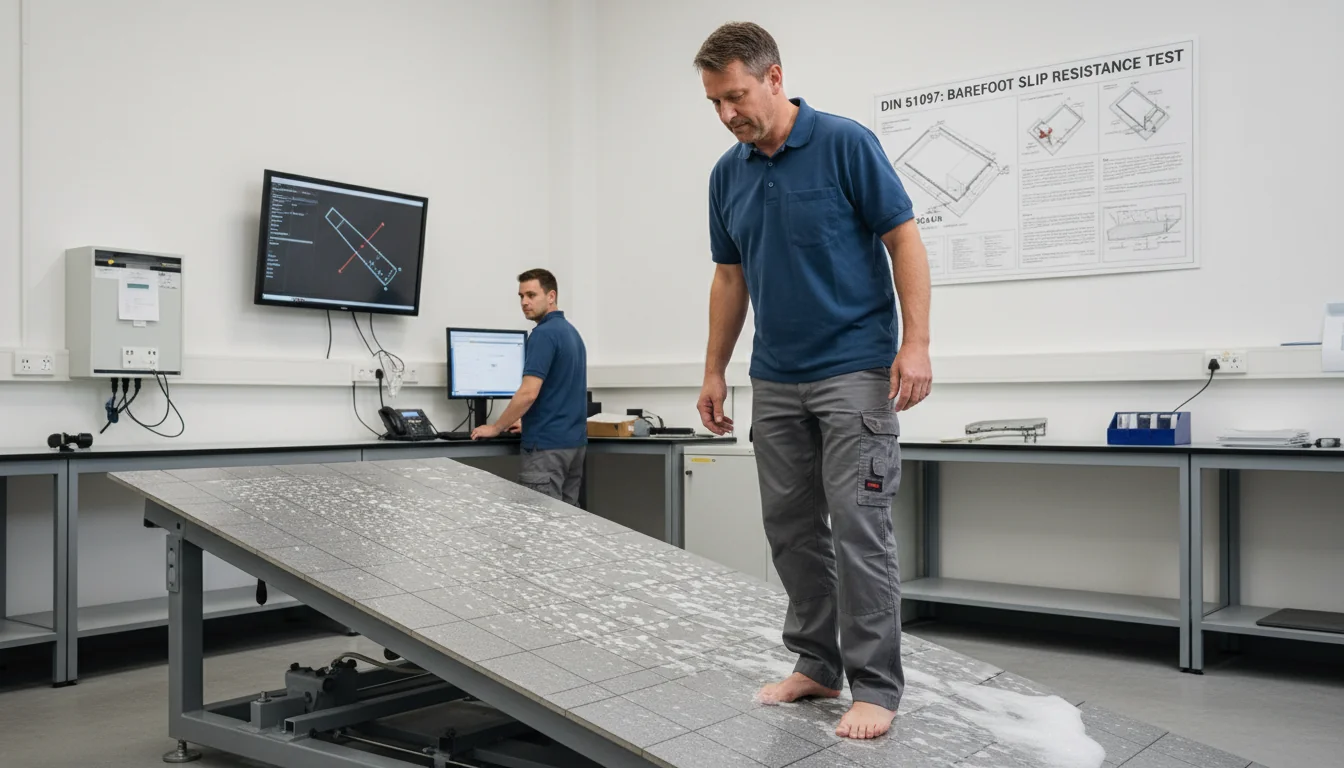
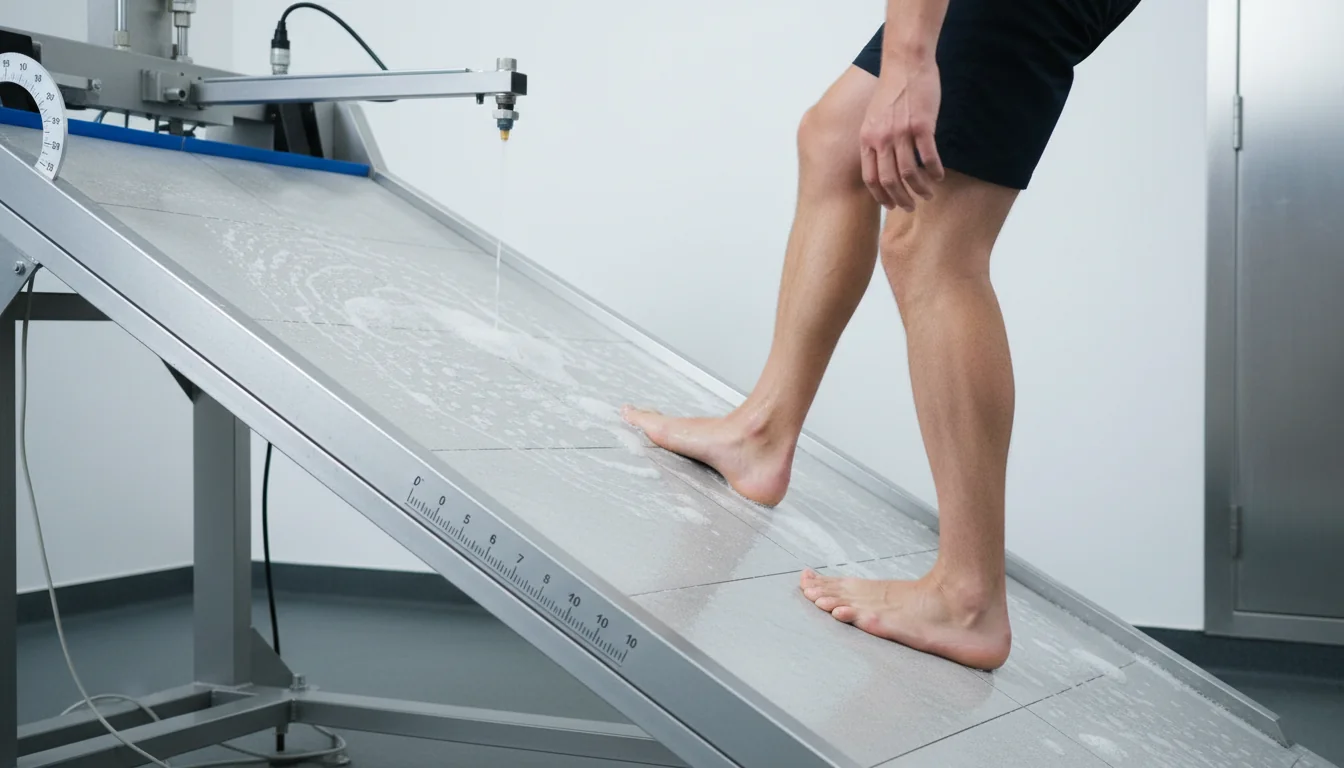
DIN 51097 determines barefoot slip resistance on a wet, inclined plane. Trained operators walk on the test surface with soapy water until the limit angle where a slip occurs is reached.
- Contaminant: water with a wetting agent (soapy solution) to mimic showers and pools.
- Outcome: acceptance angle used to classify A, B or C for barefoot areas.
- Scope: ceramic tiles, porcelain, stone, mosaics, resin, mats and gratings.
- Human factor: gait and skin contact are integral, reflecting real barefoot traction.
- Not an on‑site test: it is laboratory-based; in-situ checks use other methods.
Record both the class and the measured angle; the angle shows how far beyond a threshold your surface performs.
Why it matters for resistance: angle-based classification captures real contact between skin and surface, giving a direct indication of barefoot grip under water film and soap.
Class clarity: ABC explained
ABC groups translate the ramp angle into simple categories for barefoot zones. Higher class equals stronger wet grip and lower slip probability.
| DIN 51097 class | Typical barefoot use (wet) |
|---|---|
| Class A (≥12° to 17°) | Changing rooms, dry-to-damp walkways with occasional splashes |
| Class B (18° to 23°) | Showers, pool surrounds, spa platforms |
| Class C (>24°) | Pool steps, sloped entries, walk-through channels |
- Class A indicates basic barefoot security where pooling water is limited.
- Class B offers stronger traction for constant wetness and shampoo residues.
- Class C is the highest barefoot rating for immersion, slopes and turbulent water.
- Embossing with mineral particles can raise grip by increasing peak-to-valley contact.
Over‑texturing may trap residues and increase cleaning effort. Balance traction and hygiene.
In 2026, specs for pools commonly require Class C for steps and at least Class B around the perimeter to ensure continuous slip resistance.
Shoes vs skin: matching tests
DIN 51130 assesses shod feet using oil on the ramp and yields R-ratings (R9–R13). DIN 51097 assesses skin-to-surface contact with soapy water and yields ABC. Both use inclination but for different contact conditions.
- R-ratings: R9 (lowest) to R13 (highest) for footwear scenarios.
- ABC: A (lowest) to C (highest) for barefoot scenarios.
- Use both where people alternate between shoes and bare feet.
- Pool surrounds often specify at least R11 plus Class B or C.
EN 16165 consolidates ramp and tribometer methods across Europe. Annex A covers barefoot ramp testing; results are now expressed as an angle, with classification sometimes added nationally.
Because the contaminants and contact differ, you should not directly convert R to ABC. Treat them as complementary views of slip resistance for distinct uses.
Evidence in use: PTV links
On site, many practitioners verify slipperiness with the pendulum test. It provides a Pendulum Test Value (PTV) that correlates to slip potential on pedestrian surfaces.
| PTV (wet) | Slip potential (straight walking) |
|---|---|
| <25 | High risk; poor traction |
| 25–35 | Moderate risk; caution advised |
| ≥36 | Low risk; robust wet grip |
- PTV uses sliders for shod and barefoot assessments; both can be relevant.
- Heavily profiled surfaces may need complementary checks beyond pendulum alone.
- For sloped floors, target higher PTV to counter reduced contact under incline.
PTV ≥36 in wet use is a widely adopted low-slip benchmark. Pair this with an appropriate DIN 51097 class for barefoot zones.
This dual approach strengthens your evidence base for slip resistance under real contaminants and usage patterns.
Area-by-area: right rating
Focus on contaminants, barefoot or shod use, slope and cleaning. The goal is reliable traction where water and soap are routine.
- Domestic showers: Class B; aim for wet PTV ≥36 where feasible.
- Pool surrounds: Class B minimum; steps and slopes: Class C.
- Spa footbaths and walk-through pools: Class C for immersed approach.
- Saunas and cold plunges: Class B for decks; Class C for entries.
- Mixed use (barefoot/shod): combine ABC with an R-rating, often R11.
| Wet barefoot zone | Target classification |
|---|---|
| Shower floors, wet rooms | B + PTV check |
| Pool edge, splash zones | B to C depending on exposure |
| Stairs into water, beach entries | C (highest barefoot traction) |
Inclines and turning points raise slip risk. Increase class or micro-roughness where slopes or tight corners exist.
Health and safety Topics like Slips, Trips and Falls on pedestrian surfaces emphasise Measuring Slip Resistance under Standards; use that mindset when choosing ABC class.

Sustaining grip: care that lasts
Initial rating is only half the story. Sustained slip resistance depends on cleaning, wear and the integrity of the textured layer.
- Clean regularly to remove biofilm, oils and shampoo residues that mask texture.
- Avoid sealers that glaze micro-roughness unless proven not to reduce traction.
- Prefer surfaces where aggregates are through the wear layer, not just a thin top coat.
- Re-test in use with pendulum or tribometer as part of safety audits.
A water film just microns thick can reduce contact. Effective micro-roughness breaks that film, restoring skin-to-surface friction.
This ensures the surface’s slip resistance remains consistent over time, not just at installation.
How to verify a DIN 51097 claim
- Request the lab report: confirm barefoot ramp test, soapy water, test angle and class.
- Check the acceptance angle vs. class thresholds; look for a healthy margin.
- Match the class to the area: B for showers, C for steps and sloped entries.
- For mixed use, cross-check an R-rating and, if possible, a wet PTV.
- Plan maintenance that preserves micro-roughness and drainage.
For domestic wet rooms, a stable, larger mat size improves coverage and grip continuity—see long shower mat as a sizing reference.
Do not assume R and ABC are interchangeable. Specify per use: shod vs. barefoot.
What is the DIN 51097 barefoot rating?
It classifies barefoot slip resistance on a wet ramp into A, B or C based on the angle at which slipping occurs. It reflects real skin contact under soapy water.
How do ABC classes differ from R-ratings?
ABC is for barefoot, soapy water; R9–R13 is for footwear with oil. Use ABC for showers and pools, and R for kitchens or mixed-use walkways. Do not convert directly.
Which class for home showers and wet rooms?
Class B is a sensible target for sustained wet grip. For extra safety, choose textures that also test well in wet PTV checks on site.
What about pool steps and sloped entries?
Class C provides the highest barefoot traction on angles and submerged steps, where water turbulence and soaps increase slip risk.
How does EN 16165 affect my choices in 2026?
It harmonises methods; Annex A describes the barefoot ramp. Results are angles, and some countries add ABC classification in national annexes for clarity.
Any material tips for better barefoot traction?
Look for controlled embossing and mineral texture that break water films. Example textures include pebble-like patterns—see a pebble‑texture reference for the concept.
How do I maintain slip performance over time?
Clean routinely with suitable detergents; avoid coatings that smooth micro-roughness. Periodically verify with pendulum testing to track performance.
DIN 51097 gives you a clear, angle-based barefoot classification so you can select and maintain surfaces with dependable wet grip in 2026.
- Ramp logic: A/B/C reflect real barefoot traction under soapy water.
- Right place, right class: B for showers; C for steps and slopes.
- Verify in use: combine ABC with wet PTV checks and sound cleaning.
Apply these principles and your wet floors will deliver the slip resistance people count on.

0 comments